
How Interior Designers Charge Fees in India: 4 Models Compared
Percentage, per sq ft, lump sum or hourly: how each interior design fee model works in India, where each one hurts, and how to collect fees in stages.
By the Interioflow team · · 8 min read
Interior designers in India usually charge in one of four ways: a percentage of the project cost, a rate per square foot, a fixed lump sum, or an hourly rate for consultations. Most studios end up combining two of them, and the bigger question is rarely the number. It's what the fee is calculated on and when you collect it.
We've seen good studios lose money not because their fee was too low, but because it was tied to the wrong thing or collected too late. This piece walks through each model honestly, with a comparison table, and then gets into staged collection, which is where most of the pain actually lives.
The four fee models, side by side
The ranges below are illustrative examples only, not market rates. Fees vary hugely by city, studio reputation, project type and whether you're doing design-only or design plus execution. Use the numbers to see how the models behave, not to set your own price.
| Model | How it's calculated | Illustrative example (not a market rate) | Works well when | Where it hurts |
|---|---|---|---|---|
| Percentage of project | A % of the total execution cost | Say 8–12% of a ₹30,00,000 fit-out, i.e. ₹2,40,000–₹3,60,000 | Scope is likely to grow; you're managing execution | Clients suspect you inflate costs to earn more |
| Per sq ft | A rate × carpet or built-up area | Say ₹100–₹250 per sq ft on a 1,200 sq ft 3BHK, i.e. ₹1,20,000–₹3,00,000 | Design-only work; repeat flat layouts | Upgrades and extra rooms don't increase your fee |
| Lump sum | One fixed amount for an agreed scope | Say ₹2,00,000 for design and drawings of a 3BHK | Scope is tight and well defined | Every "small change" eats into your margin |
| Hourly | A rate × hours spent | Say ₹1,500–₹3,000 per hour for a consultation | Advice, site visits, one-off reviews | Clients watch the clock; hard to forecast |
Again, those figures exist to make the arithmetic visible. If someone tells you there's a "standard" interior designer fee percentage in India, ask them where it's written down. There isn't one.
Percentage of project cost
This is the most common model for studios that handle execution. You agree a fee percentage, and it's applied to the final cost of the work.
The appeal is obvious. When the client in Baner decides halfway through that the guest room also needs a wardrobe, a study unit and a false ceiling, your fee grows with the work. You don't have to renegotiate every addition.
The catch is trust. Some clients quietly assume you'll push expensive options because it lifts your fee. You can't fully remove that suspicion, but you can blunt it:
- Agree in writing what the percentage applies to. Civil, carpentry, electrical, painting? Loose furniture the client buys directly? Appliances? Material you procure at a markup?
- Calculate the fee on approved quotations only, not on early estimates the client never signed.
- Show the fee as its own line, separate from material and labour, so nobody has to dig for it.
That middle point matters more than people think. If you charge a fee on a quotation the client later cuts by 30%, you've billed on money that was never spent, and you'll be refunding it awkwardly at handover.
In Interioflow, the designer fee % is set when the site is created, along with whether it applies to material, and it locks as soon as the first quotation is approved. The fee earned is then worked out from approved quotations, so instalments can't run ahead of the work the client has actually agreed to. More on that on our payments page.
Per square foot
Per sq ft pricing is popular with independent designers doing design-only projects, and clients love it because they can do the maths themselves before the first meeting.
It's clean for a straightforward 2BHK in a society where every flat has the same layout. It gets messy fast when:
- the area is disputed (carpet vs built-up vs super built-up can differ a lot),
- the client wants one room done in great detail and three rooms barely touched,
- the scope shifts from "just the kitchen and living" to "actually, everything".
If you price per sq ft, define the area basis in the agreement and list exactly which rooms and deliverables are included. Then decide now what happens when they add the balcony and the puja unit. You'll need that answer in month three, and it's much easier to point at a clause than to argue over the phone.
Lump sum
A fixed fee for a fixed scope. It's honest and simple, and it protects the client from surprises. It protects you only if the scope is genuinely fixed, which in residential interiors it almost never is.
We've watched studios quote a lump sum for a villa, then go through four revisions of the kitchen because the client's mother-in-law didn't like the laminate shade. Each revision was "just a small change". Together they ate the entire profit on the project.
If you use a lump sum, cap the revisions. Something like "two rounds of revisions per drawing set; further revisions billed at ₹X per round" is fair to both sides. And keep a written record of every approved design decision so you can show when something genuinely changed versus when it's a re-do of something already signed off. Our guide on scope creep in interior projects goes into this in more detail.
Hourly
Hourly billing rarely works for a full project in India. Clients aren't used to it, and nobody wants a running meter on their home. Where it does work is consultations: a two-hour session to review a builder's layout before possession, a site visit to check a contractor's work, a colour consultation.
Some studios charge a consultation fee and adjust it against the full fee if the client signs up. That's a neat way to filter out people who only want free ideas.
Mixing models (what most studios actually do)
Pure models are rare. Common combinations we see:
- Lump sum for design + percentage on execution. The design fee is earned regardless of whether the client goes ahead with you for execution.
- Percentage with a minimum fee. Protects you on small projects where 10% of not much is not worth your time.
- Per sq ft for design + a separate fee for site supervision. Useful when the client wants to hire their own contractor.
There's no perfect answer here. Pick the structure that matches how much of the project you control. The more you control, the more a percentage makes sense; the less you control, the more you want a fixed amount for what you deliver.
How to collect fees in stages
This is where fee models succeed or fail. A brilliant fee structure means nothing if the last 30% is stuck for six months after handover because the client is "waiting for the bonus".
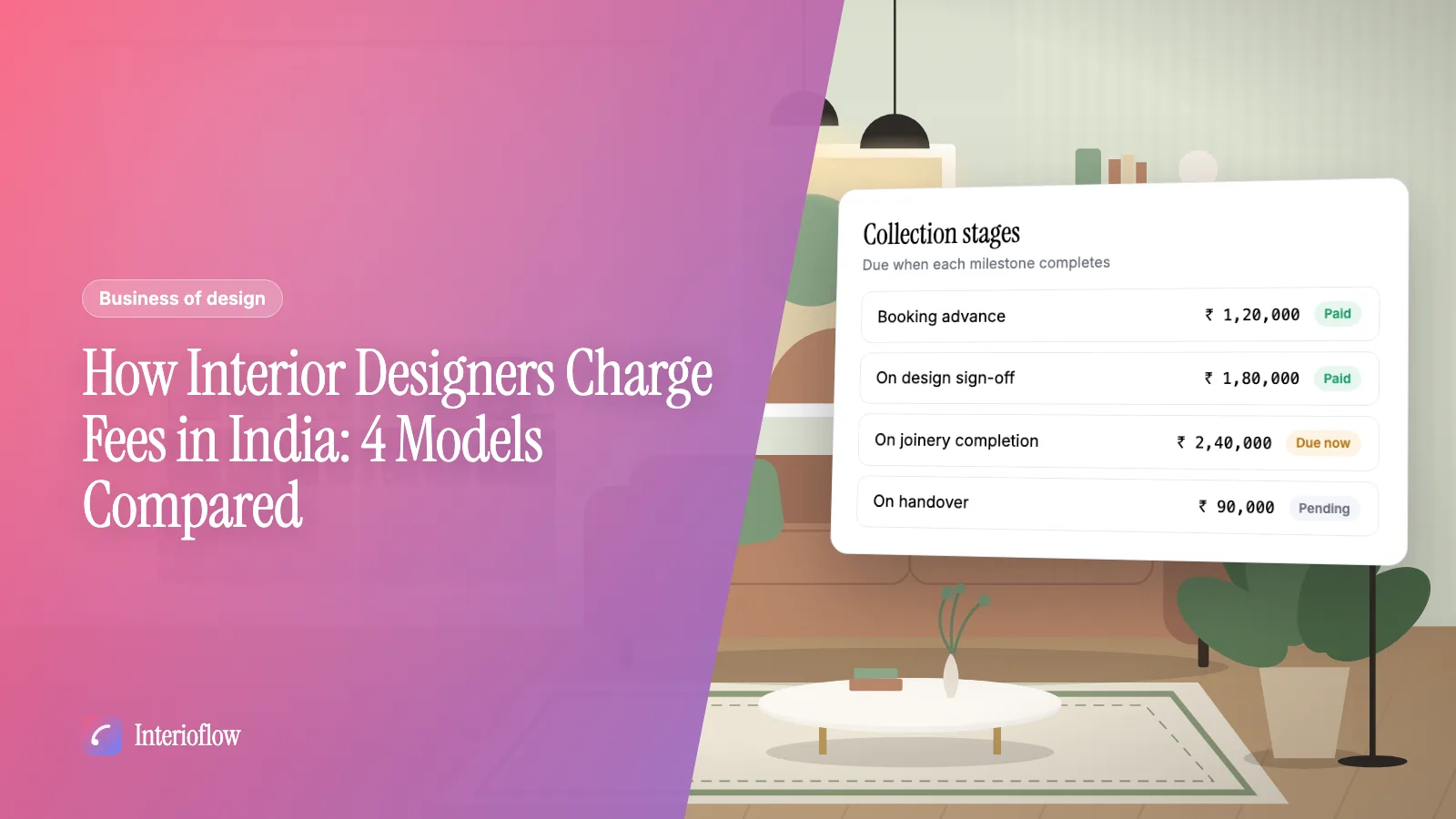
A staged schedule that ties each payment to something the client can see works far better than calendar dates. A typical layout looks like this:
- Advance on signing: before any drawings leave the studio.
- Design sign-off: layouts, 3D views and material palette approved.
- Execution start: carpentry or civil work begins on site.
- Mid-execution: when a visible chunk like modular kitchen installation is done.
- Handover: keep this stage small.
A few hard-won rules:
- Front-load a little. Your effort is heaviest in design. If most of your fee comes at the end, you're financing the client's project.
- Keep the final stage small. Snags, a delayed sofa, a cracked tile: there will always be a reason to hold the last payment. Make it a reason that doesn't cost you much.
- Make the stage visible. "Pay when the kitchen is installed" is easier to accept than "Pay on 15 November", especially if the client can see the photos.
- Raise GST properly. Your professional fee attracts GST if you're registered. Put it on the invoice from the first stage so it's never a surprise later.
In Interioflow you can set the fee to be collected per milestone or at the end, and add collection stages tied to milestones. When a milestone is marked complete, the stage falls due and the client gets a notification. They see what's paid and what's pending on their own Costs screen in the client portal, which cuts down a lot of "how much do I owe you again?" calls.
If you're working solo and trying to set this up for the first time, our page for independent designers shows how the pieces fit together.
Quick answers
How do interior designers charge in India? Most use one of four models: a percentage of the project cost, a rate per square foot, a fixed lump sum, or an hourly rate for consultations. Many studios mix them, for example a lump sum for design and a percentage on execution.
Is a percentage fee or a per sq ft fee better for an interior designer? A percentage fee grows with the budget, which suits projects where the scope is likely to expand. A per sq ft fee is easier for clients to understand upfront but doesn't move when they upgrade from laminate to veneer, so you can end up doing more work for the same money.
Should the designer fee be charged on material cost too? That is a choice you should write into the agreement on day one. Some studios charge the fee on the full project value including material, others only on civil, carpentry and services. Whichever you pick, say it plainly so there's no argument at the final bill.
When should an interior designer collect fees? Collect an advance before design work starts, then tie the rest to clear milestones such as design sign-off, carpentry start and handover. Avoid leaving a large chunk for after handover, because that's the payment most likely to get stuck.