
Interior Design Quotation Format (With a GST Sample)
A clear interior design quotation format for Indian studios: what each line should say, how to show GST, a sample table and the mistakes that cause disputes.
By the Interioflow team · · Updated · 8 min read
A good interior design quotation format lists every item as its own line with a description, specification, unit, quantity, rate and amount, then shows the subtotal, GST and grand total separately. Add your GSTIN, a quotation number and version, what's not included, payment terms and a validity date. If a client can read it without calling you to ask "what does this include?", the format is working.
Most quotation trouble doesn't come from the numbers. It comes from vague lines like "Kitchen: ₹2,80,000" that mean one thing to you and another to the client. Below is the layout we'd recommend, a sample with GST worked out, and the mistakes that tend to come back at handover.
The parts of an interior quotation, top to bottom
Think of the quote as a document someone will reread months from now, probably while annoyed. Everything they'd need to settle a question should be on it.
- Header. Studio name, address, GSTIN, phone and email. Client name and the site address (not just the client's office).
- Quote reference. A quotation number, a version (v1, v2…) and the date. Version numbers matter more than people think; we'll come back to that.
- Scope summary. Two or three lines: "Interiors for 3BHK, Flat 702, Baner, Pune: modular kitchen, master wardrobe, living room ceiling and painting."
- Line items. The body of the quote, grouped by room or by trade.
- Totals. Subtotal, GST split, grand total, ideally with the total in words too.
- Exclusions. What you are not doing.
- Payment terms. Stages, percentages and what triggers each one.
- Validity and notes. How long the prices hold, lead times, and anything conditional.
None of this is new. What separates a good quote from a risky one is how specific the line items are.
What a good line item says
A line item should let a stranger (or a carpenter, or the client's CA) understand exactly what's being supplied. Compare:
Wardrobe – ₹92,400
with:
Master bedroom wardrobe, 7 ft W × 8 ft H, 18 mm BWP ply carcass, 1 mm laminate outside, 0.8 mm liner inside, shutter laminate as per approved sample – 56 sq ft @ ₹1,650
Same price. The second one tells the client what they're getting, tells your team what to build, and settles the "I thought the inside would be laminated too" conversation before it starts.
For each line, try to cover:
- What it is and where it goes (room or wall).
- Material and grade: ply type and thickness, laminate thickness, make of hardware.
- Unit that matches how it's built: sq ft for wardrobes and ceilings, running ft for kitchen units, numbers for hardware sets or lights, lump sum only when nothing else fits.
- Quantity, rate and amount, with the arithmetic visible.
- GST rate for that line.
A note on brands: if you write "Hettich or equivalent", you've given yourself flexibility and the client a reason to doubt you. Either name the make or say "as per approved sample" and actually get the sample approved. (We wrote about getting that sign-off in how to get client approvals in writing.)
A sample quotation with GST
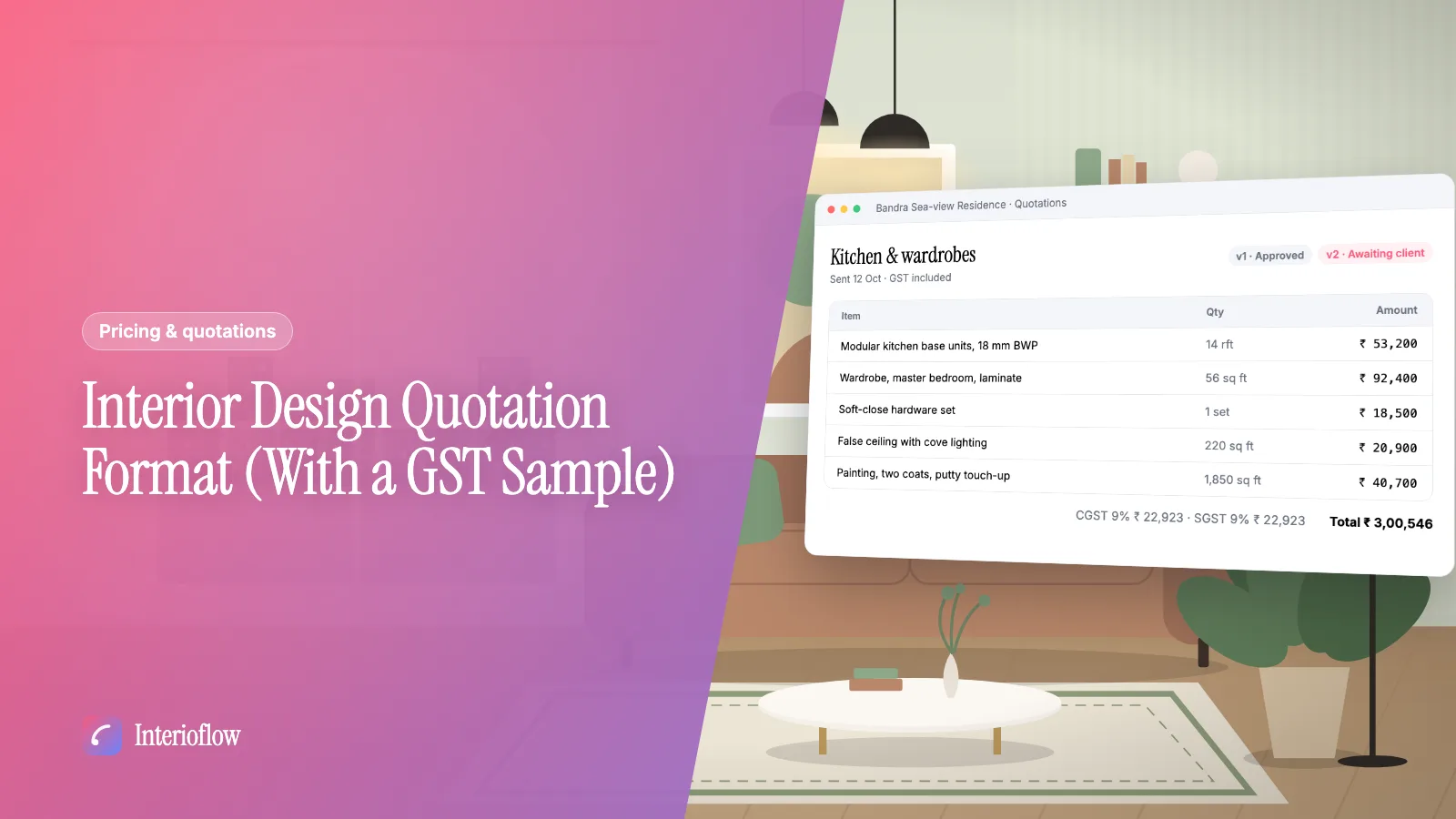
Here's a cut-down example for part of a 3BHK in Pune. The rates are illustrative, not a price guide; your city, your vendors and your finish level will change them a lot. The GST rate is shown at 18% on every line to keep the arithmetic simple. In practice, confirm the current rate for each item's HSN or SAC code, because different materials and services can fall under different rates.
| # | Item and specification | Unit | Qty | Rate (₹) | Amount (₹) | GST |
|---|---|---|---|---|---|---|
| 1 | Kitchen base units, 18 mm BWP ply carcass, 1 mm laminate shutters, as per drawing K-02 rev B | rft | 14 | 3,800 | 53,200 | 18% |
| 2 | Kitchen wall units, 18 mm BWP ply, 1 mm laminate shutters, as per K-02 rev B | rft | 10 | 2,900 | 29,000 | 18% |
| 3 | Master bedroom wardrobe, 7 × 8 ft, 18 mm BWP ply, 1 mm laminate outside, 0.8 mm liner inside | sq ft | 56 | 1,650 | 92,400 | 18% |
| 4 | Kitchen and wardrobe hardware: soft-close hinges, tandem drawer channels, as per approved sample | set | 1 | 18,500 | 18,500 | 18% |
| 5 | Living room false ceiling, gypsum board on GI framing, cove for profile light (lights excluded) | sq ft | 220 | 95 | 20,900 | 18% |
| 6 | Painting, two coats emulsion over one coat primer, walls and ceiling, including putty touch-up | sq ft | 1,850 | 22 | 40,700 | 18% |
| Subtotal | 2,54,700 | |||||
| CGST @ 9% | 22,923 | |||||
| SGST @ 9% | 22,923 | |||||
| Grand total | 3,00,546 |
Rupees three lakh five hundred and forty-six only.
A few things to notice. Each line points back to a drawing or an approved sample, so the quote and the design can't drift apart quietly. The ceiling line says the lights are excluded, which saves a conversation later. And the GST is split into CGST and SGST because the client is in the same state as the studio. For a client in another state, you'd show a single IGST line instead.
GST on interior quotations: the bits people get wrong
We're not tax advisers, and you should have your CA look at your setup once. But a few points come up with almost every studio.
Show GST, don't bury it. Quoting "₹3,00,000 all inclusive" feels friendlier, but the client's CA will ask for the breakup, and so will a corporate client. Show the subtotal, the tax and the total.
Put your GSTIN on the quote. It's a small thing that makes you look like a business rather than a contractor with a letterhead.
Know your codes. Materials carry HSN codes; services like design and installation carry SAC codes. If your quotation lines already carry the right code and rate, turning an approved quote into a tax invoice is far less painful.
Decide whether your design fee sits on the quote. Some studios add it as a line; others bill it separately as a percentage. Either is fine, as long as the client can see it clearly and it isn't hiding inside material rates. Our piece on how interior designers charge fees goes into the options.
Mistakes that cause disputes at handover
These are the ones we see most, roughly in order of how much grief they cause.
Per-square-foot packages with no breakup. "Full home interiors at ₹1,450 per sq ft" is a fine marketing line and a terrible contract. What's in it? Is the kitchen chimney included? The geyser? Itemise before the client approves.
No exclusions section. If electrical fittings, civil work, appliances, curtains or deep cleaning aren't yours, write that down. Clients assume an interior designer does "everything" unless told otherwise.
Editing an approved quote instead of versioning it. The client approves ₹3,00,546. Then they add a study table. If you edit the same document, the approved number disappears. Make the addition a new version or a separate quotation, and get that approved on its own. The total for the site is the sum of what's been approved.
No validity date. Ply and hardware prices move. A quote from February approved in July is a problem waiting to happen.
Showing your purchase cost or markup by accident. It happens more than anyone admits, usually by forwarding the wrong Excel tab. The client should see the price you're charging, not what you paid the vendor.
Building quotations in Interioflow
We built quotations in Interioflow around exactly these problems, so it's worth a short mention here.
You build a quotation from the material already assigned to a site, plus labour and custom lines, each with quantity, rate, GST and a description, along with a title and notes. Catalog materials carry their HSN code and GST % so you're not looking them up each time. Revisions become new versions with a full change log, and approved versions add up, so the site total is always the sum of everything the client has actually approved. Your purchase rate and markup stay internal; the client only ever sees the final price.
When it's ready, you send it and the client gets an email with the PDF attached. They approve or reject from their portal by confirming a 6-digit code emailed to them, and you're notified straight away. If your studio wants a senior person to check every quote first, you can switch on an internal sign-off before anything goes out. The quotations feature page has more detail, and pricing is on its own page.
Quick answers
What should an interior design quotation include? Your studio and GSTIN details, the client and site address, a quotation number with version and date, then line items with description, specification, unit, quantity, rate and amount. Finish with GST, the total, what's excluded, payment terms and how long the quote is valid.
How do I show GST on an interior quotation? Show the rate against each line and add the tax up below the subtotal, split as CGST and SGST for a client in your state or IGST for one outside it. Put your GSTIN on the quote, and HSN or SAC codes against the lines if you're issuing tax invoices from the same data.
Should I quote per square foot or itemised? Per square foot is fine for a first ballpark, but the quotation the client approves should be itemised. A per-square-foot number hides what's included, which is exactly where arguments start at handover.
How long should an interior quotation be valid? Fifteen to thirty days is common, because ply, laminate and hardware prices move. Say it clearly on the quote, and say what happens if the client approves after it lapses.