
Scope creep in interior projects: how to charge for extras
How to spot scope creep on an interior site, charge fairly for extra work and design revisions, and get the client's yes in writing before work starts.
By the Interioflow team · · 8 min read
Scope creep in interior design is the slow pile-up of "small" extras that nobody priced and nobody signed for: one more loft, a laminate swapped after the sheets were cut, a third round of kitchen layouts. You stop it by writing down what your fee covers before you start, putting a price and a date on every change before anyone builds it, and getting the client's yes in writing each time. The goal isn't to refuse extra work. It's to stop doing it for free by accident.
Most designers we talk to don't lose money on the big decisions. They lose it on twenty little ones that each felt too awkward to charge for.
How scope creep actually turns up on site
It almost never arrives as a big request. Picture a 3BHK in Pune. The kitchen, three wardrobes, a TV unit and the master bedroom are agreed and quoted. Then, over six weeks:
- "Since the carpenter is already here, can he do a small shoe rack by the door?"
- The client's mother-in-law visits and decides the wardrobe laminate is too dark. The sheets are already pressed.
- "Can we just add profile lights in the TV unit?" The electrician has closed the walls.
- The client sees a friend's home and wants the balcony done "in the same style, quickly".
- The layout you finalised in March gets reopened in May, because the son has decided he wants a study table after all.
Each one is reasonable on its own. Nobody is being difficult. But the shoe rack takes two carpenter days, the laminate change wastes material you've already paid for, the profile lights mean chasing a wall, and the balcony is a whole new design. If none of it was written down and priced, it comes out of your fee.
The other problem is time. Every extra pushes handover, and at the end the client remembers the late handover, not the six favours.
Write down what's included before the first drawing
You can't call something "extra" if you never said what the base was. The proposal or agreement needs to say, in plain words, what's in and what's out. It doesn't have to be a legal document. It has to be specific enough that both sides can point at it later.
| Write down | Example |
|---|---|
| Rooms and items covered | Kitchen, 3 wardrobes, TV unit, master bed back panel |
| What's not covered | Civil work, balcony, loose furniture, appliances, false ceiling in bedrooms 2 and 3 |
| Design revision rounds | Two rounds per room on layout, two on 3D views |
| Site visits included | Weekly during execution, extra visits charged |
| How changes are handled | Every change priced and approved in writing before work starts |
| What happens to material already bought | Charged to the client if a change makes it unusable |
That last row saves more arguments than any other. If the client changes a finish after you've bought it, someone pays for the old sheets. Agree now that it's them, unless the mistake was yours.
Design revisions: how many are free, and what the next one costs
Revisions are where independent designers bleed the most, because the work is invisible. The client sees "one small change to the layout". You see two evenings redrawing, re-rendering and re-checking every elevation that depended on it.
Pick a number of rounds and say it out loud. We'd suggest two rounds per drawing set, but there's no perfect answer. A studio doing high-end villas might allow three, and a designer on a tight fee might allow one. What matters is that the client knows the number before round one.
Then decide how you charge past it. There are three common ways:
- A flat fee per extra round. Simple to explain, and clients understand it. It can feel harsh if the change is tiny.
- An hourly or daily rate. Fair to both sides, harder to estimate up front, and some clients will argue the hours.
- A small bank of extra rounds sold in advance. Works well for clients you already know will change their minds a lot.
There's also a line to draw between a revision and a new brief. Moving the bed to the other wall is a revision. Approving a modern grey kitchen and then asking for a Chettinad-style one in teak is a new design, and it should be quoted as one. Say that kindly, and early.
Pricing a change during execution
Once work is on site, every change needs a short written note before anything happens. Call it a change order, a variation or an extra item; the name doesn't matter. What it holds does:
- What exactly is changing (the wardrobe shutters move from 1 mm laminate to acrylic).
- Who asked for it and when.
- The cost difference, with GST shown separately.
- What happens to material already bought or fitted, and what that costs.
- How many days it adds, and the new handover date if it moves.
- The client's approval, in writing, with a date.
Say the kitchen was quoted with MR-grade ply and the client wants BWP after hearing a horror story from a neighbour. The note might read: "Upgrade kitchen base units to BWP ply, extra ₹38,000 plus GST at 18%, ₹6,840, total ₹44,840. No change to handover." Clear, one line, and nobody can say later they didn't know.
Don't skip point 5 because the change is small. Three "small" changes that each add four days are a fortnight. If you don't move the date in writing, you're the one who's late.
Get the yes before the carpenter picks up the saw
This is where most studios fall down. The change is discussed on a site visit, the client nods, someone says "haan, theek hai, go ahead" on a WhatsApp voice note, and the work starts. Six weeks later the final bill arrives and the client honestly doesn't remember agreeing to ₹44,840.
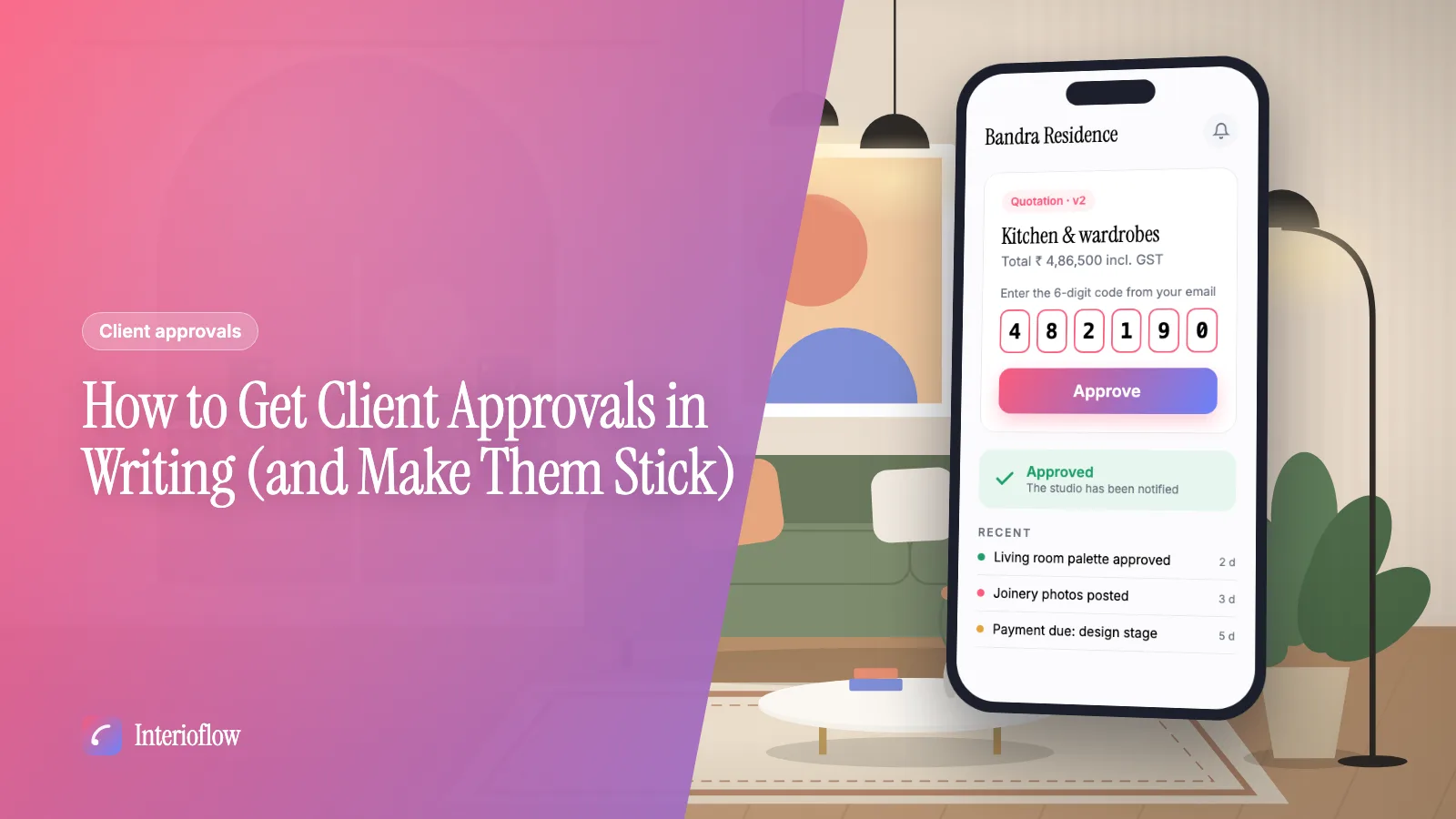
A verbal yes isn't enough, and a thumbs-up in a group chat isn't much better. We've written more about this in how to get client approvals in writing, but the short version: the approval should name the item and the amount, be tied to the client's own account or email, and be easy for both of you to find later.
We built Interioflow around this problem. An extra goes onto a new quotation version for the site, the client gets the PDF by email, and approves it with a 6-digit code sent to their email. Approved versions add up, so the site total always shows the original work plus every approved extra, and the change log shows what changed between versions. A date change works the same way: you propose the new deadline with a reason, and the client approves it with a code before it takes effect.
Saying "yes, and here's what it costs"
Most designers don't hate charging. They hate the moment of telling someone they like, who's been paying on time, that the shoe rack isn't free. A few phrases that help:
- "Happy to do it. Let me send you the cost and the time it adds, and we'll start once you've confirmed."
- "That's outside what we'd agreed for this phase, so I'll quote it separately. You can decide if it's worth it."
- "We've done two rounds on this layout, which is what's included. A third round is ₹X. Shall I go ahead?"
None of these say no. They just put the decision back with the client, where it belongs. In our experience most clients respect it. The ones who don't would have been trouble at the final payment anyway.
When to absorb something
Sometimes you'll decide a request is small enough to do free: a couple of extra handles, an hour moving a socket. Fine. Do it on purpose, and tell the client: "We've done this at no charge." Then write it down. In Interioflow you can leave material or labour lines on a site unbilled, so the cost is recorded against the site even though the client isn't charged. That way your own numbers tell you the truth about the project, and you can see when "goodwill" has quietly become ₹60,000.
Keeping count of design rounds
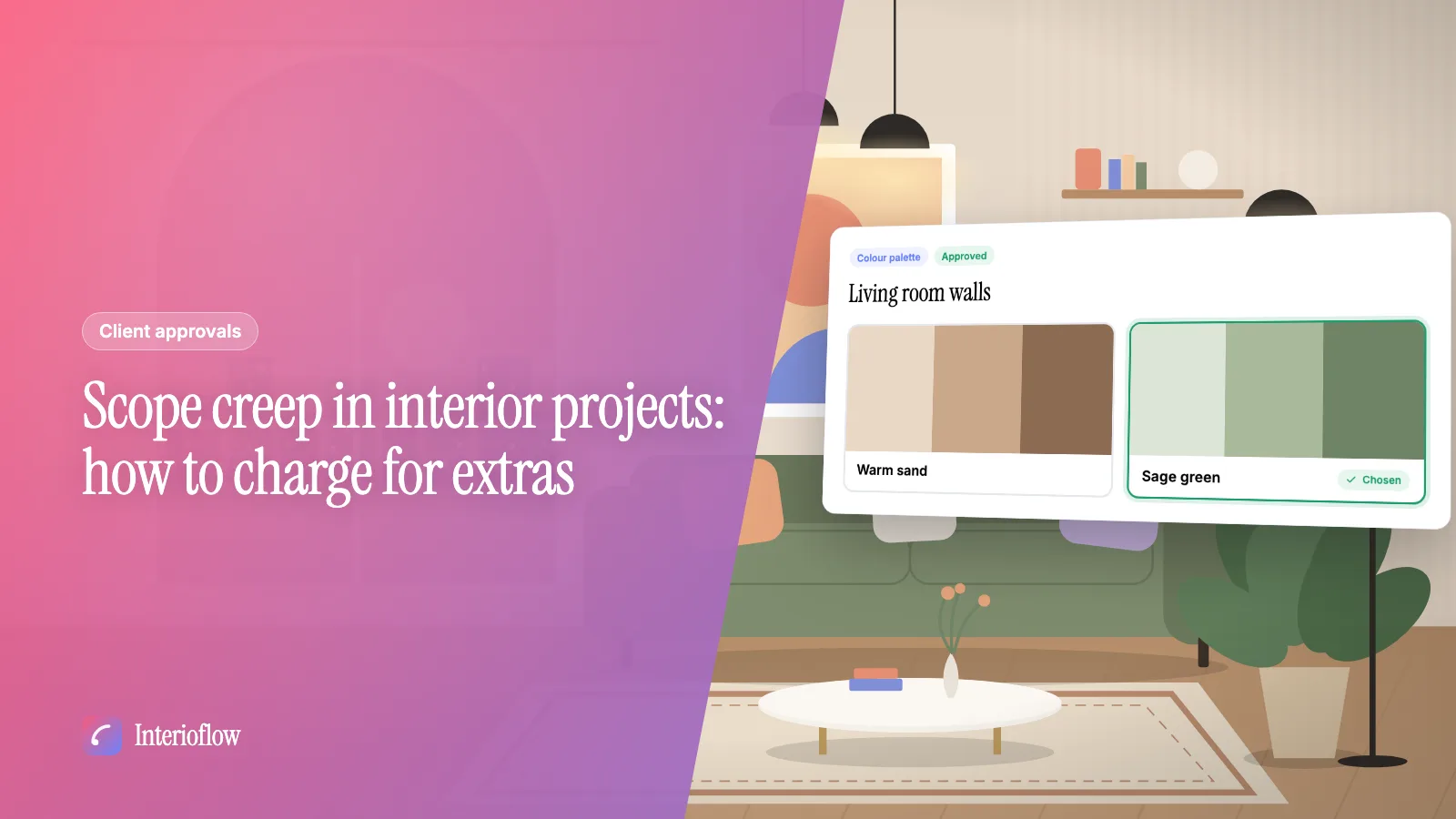
The same goes for revisions. If your agreement says two rounds, you need to know which round you're on. Interioflow's design approvals let you send a layout, 3D view or finish for sign-off. The client approves, requests changes or rejects with a reason, and each revise-and-resend becomes v2, v3 and so on, with every earlier answer kept. When a client says "but we only changed it once", the history is right there.
Quick answers
What is scope creep in interior design? Scope creep is the build-up of extra work that was never in the original agreement: another wardrobe, a changed finish, a fourth round of layout revisions. Each request looks small, but together they eat your margin and push the handover date.
How should an interior designer charge for design revisions? Fix the number of revision rounds in your proposal, often two per room or per drawing set, and name a price for each extra round. If the client changes the brief after approval, treat it as a new design and quote it separately.
What should I do when a client asks for extra work mid-project? Say yes to the conversation, not the work. Write down what changes, what it costs including GST, and how it moves the timeline, and start only after the client approves that in writing.
Should I ever do extra work for free? Sometimes, if it's small and it keeps a good relationship. Do it on purpose, tell the client it's not being charged, and record it, so the next request doesn't get treated as free too.