
How to Get Client Approvals in Writing (and Make Them Stick)
A practical way for interior designers to get client sign-off in writing: what to send, when, and how to stop a yes on WhatsApp turning into a dispute.
By the Interioflow team · · Updated · 8 min read
To get client approval in writing, send each decision as a separate request: one drawing or sample, one clear question, a reply-by date, and a record of exactly which version the client said yes to. A thumbs-up on WhatsApp doesn't count. What you want is a dated, specific "approved" that you can pull up six weeks later when someone asks why the kitchen shutters are walnut and not oak.
That's the whole idea. The rest of this article is about making it work with real clients, who are busy, who forward things to their brother-in-law, and who sometimes change their mind after the carpenter has already cut the ply.
Why verbal and WhatsApp approvals keep failing
Most disputes in residential interiors aren't about bad work. They're about memory. The client remembers saying "let's see" while you remember them saying "go ahead". Both of you are being honest.
WhatsApp makes this worse in a sneaky way. It feels like a written record, so you relax. But look at what's actually in a typical thread for a 3BHK: forty photos of laminates, three voice notes, a PDF of the kitchen layout that was revised twice, and somewhere in the middle a thumbs-up emoji from the client's husband. Which layout was that thumb for? Was the wife on board? Nobody can say.
We learned this the hard way. On one Pune flat the client's mother-in-law visited mid-project, didn't like the wardrobe laminate, and the client asked us to change it. Fair enough, except the shutters were already pressed. Our "approval" was a WhatsApp message saying "this one is nice". It was nice. It was also not enough to have a calm conversation about who pays for the second set of shutters.
What a written approval actually needs
An approval that holds up has five parts. Miss one and you're back to arguing.
- One decision per request. "Approve the kitchen" is too big. "Approve the kitchen layout, drawing K-02 rev B" is right. Laminate is a separate request. Hardware is another.
- The exact thing being approved, attached. The drawing, the render, a photo of the actual sample with its code visible. Not a link to a Pinterest board.
- A version number. If the client asks for changes, the next one is v2. They approve v2, not "the kitchen".
- A plain-English question and a reply-by date. "Please approve or tell us what to change by Friday 12th, so the carpenter can start cutting on Monday." The deadline isn't pushy; it explains why the date matters.
- A clear answer from the right person. Approve, request changes, or reject, from the person who's paying. Not the site supervisor's cousin who happened to be there.
There's no perfect format. A well-written email with an attachment and a "yes, approved" reply covers most of it. The trouble starts at volume: a single 3BHK can easily generate thirty or forty of these, and keeping them straight across email, WhatsApp and a notebook is a job in itself.
Which decisions need formal sign-off
Not everything. If you send a formal request for every cushion, clients stop reading them, and then the important ones get ignored too.
Our rule of thumb: get it in writing if it's expensive to undo or blocks someone else's work.
| Decision | Formal sign-off? | Why |
|---|---|---|
| Layout and floor plan | Yes | Everything else follows from it |
| Kitchen and wardrobe drawings | Yes | Ply gets cut from these |
| Laminates, veneers, stone, tiles | Yes | Ordered in bulk, rarely returnable |
| Lighting and electrical points | Yes | Chasing walls twice is miserable for everyone |
| Colour palette | Yes | Painters can't start without it |
| Quotation and payment terms | Yes, and binding | This is the money |
| Cushions, décor, styling | Usually no | Cheap to change, keep it light |
The quotation and payment terms deserve a stronger kind of yes than a design choice. A client can request changes to a mood board ten times and it's just a design conversation. But "I approve ₹6,40,000 plus GST, 40% on signing" should be something they consciously confirm, with no room for "I thought that was a draft". If you're working on how you present that number, our guide to an interior design quotation format walks through the line items.
When the client keeps changing their mind
Every designer has had this client. Kitchen approved in week two, reopened in week five, again in week seven after a cousin's housewarming.
You can't stop people changing their mind, and honestly you shouldn't want to. It's their home. What you can do is make the cost of a change visible, so the decision is theirs and made with open eyes.
A few things that work for us:
Approved means approved. When the client wants to change something they've signed off, don't quietly edit the old drawing. Create a new version. The old approval stays on record, the new one goes through the same process. This one habit removes most of the "but I never agreed to that" moments.
Put days and rupees on the change. "Sure, we can switch to the fluted shutters. That's ₹38,000 more and pushes the kitchen by about nine days because the laminate is a special order." Said calmly, in writing, before anything is ordered. Most clients slow down once the trade-off is in front of them. Some go ahead anyway, which is also fine, because now it's their call and it's recorded.
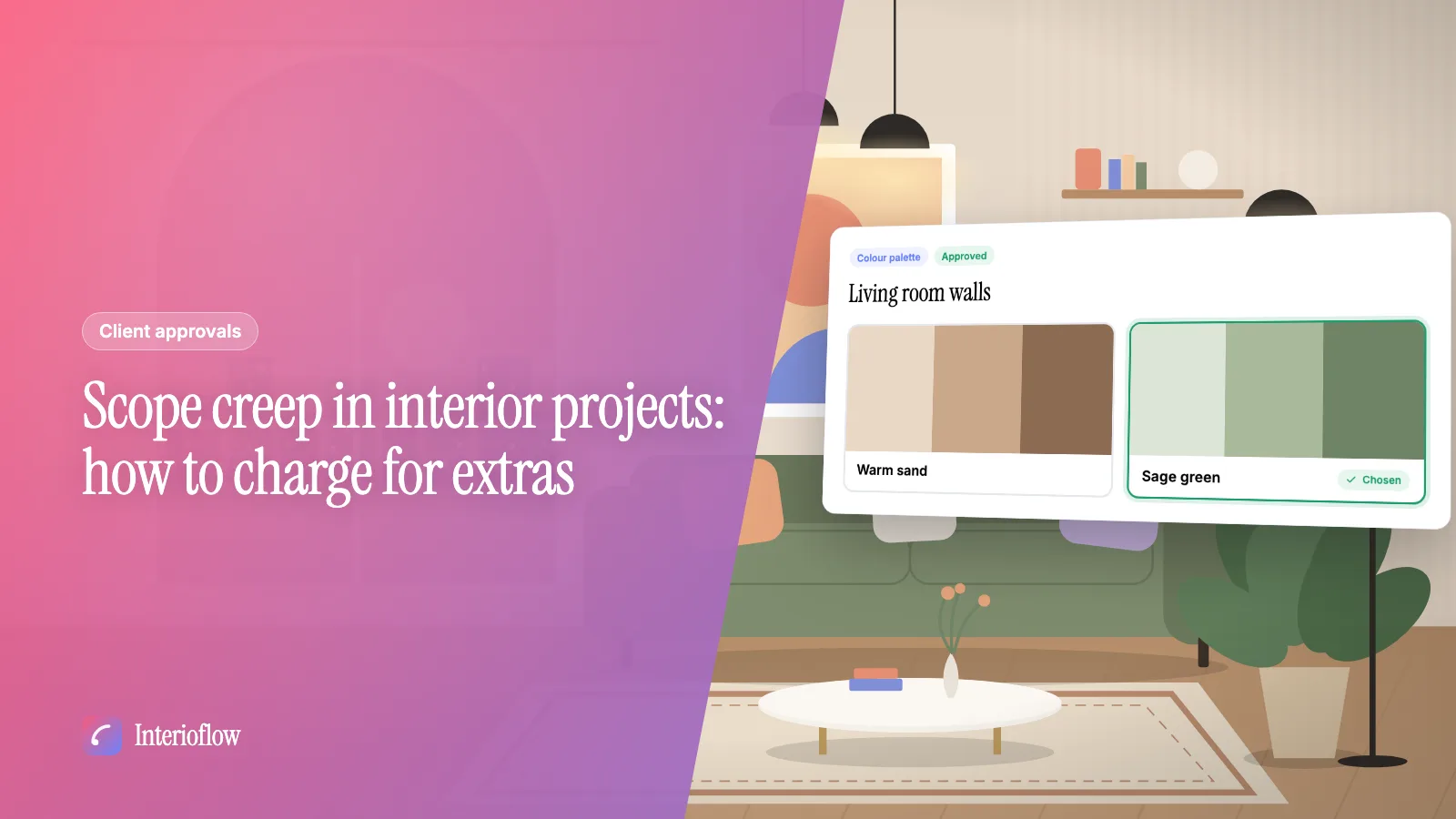
Show options up front. A lot of mind-changing is really "I didn't know there was another choice". If you send two or three laminate options side by side and ask the client to pick one, you get a firmer decision than sending one and waiting for them to go looking.
Find the real decision-maker early. If the mother-in-law has opinions, it's better to know in the concept stage than at installation. We now ask, gently, in the first meeting: "Who else will want to see the designs before you're comfortable?"
None of this is foolproof. Some clients will reopen things no matter what. But a clean history of who approved what and when turns those conversations from a fight into a quick look at the record.
Building a simple approval routine
You don't need software to start. You need a habit your whole team follows. Here's a routine that works for a small studio:
- Keep a running approvals list per site. Item, version, date sent, date answered, answer. A shared spreadsheet is fine to begin with.
- Send from one channel. If approvals go by email, they always go by email. WhatsApp can carry the nudge ("sent you the kitchen drawing on email, please check") but not the decision itself.
- Attach, don't describe. Never send "the one we discussed". Send the file.
- Follow up on the reply-by date, not after it. A polite reminder the morning before the deadline gets more answers than a frustrated one three days late.
- Don't let work start on an open item. If the carpenter is waiting on hardware approval, tell the client that, plainly. It's the most effective reminder there is.
The weak spot in all of this is effort. A spreadsheet only works if someone updates it, and on a busy week, nobody does.
How we handle approvals in Interioflow
This is the problem we kept running into ourselves, so it's the part of Interioflow we spent the most time on.
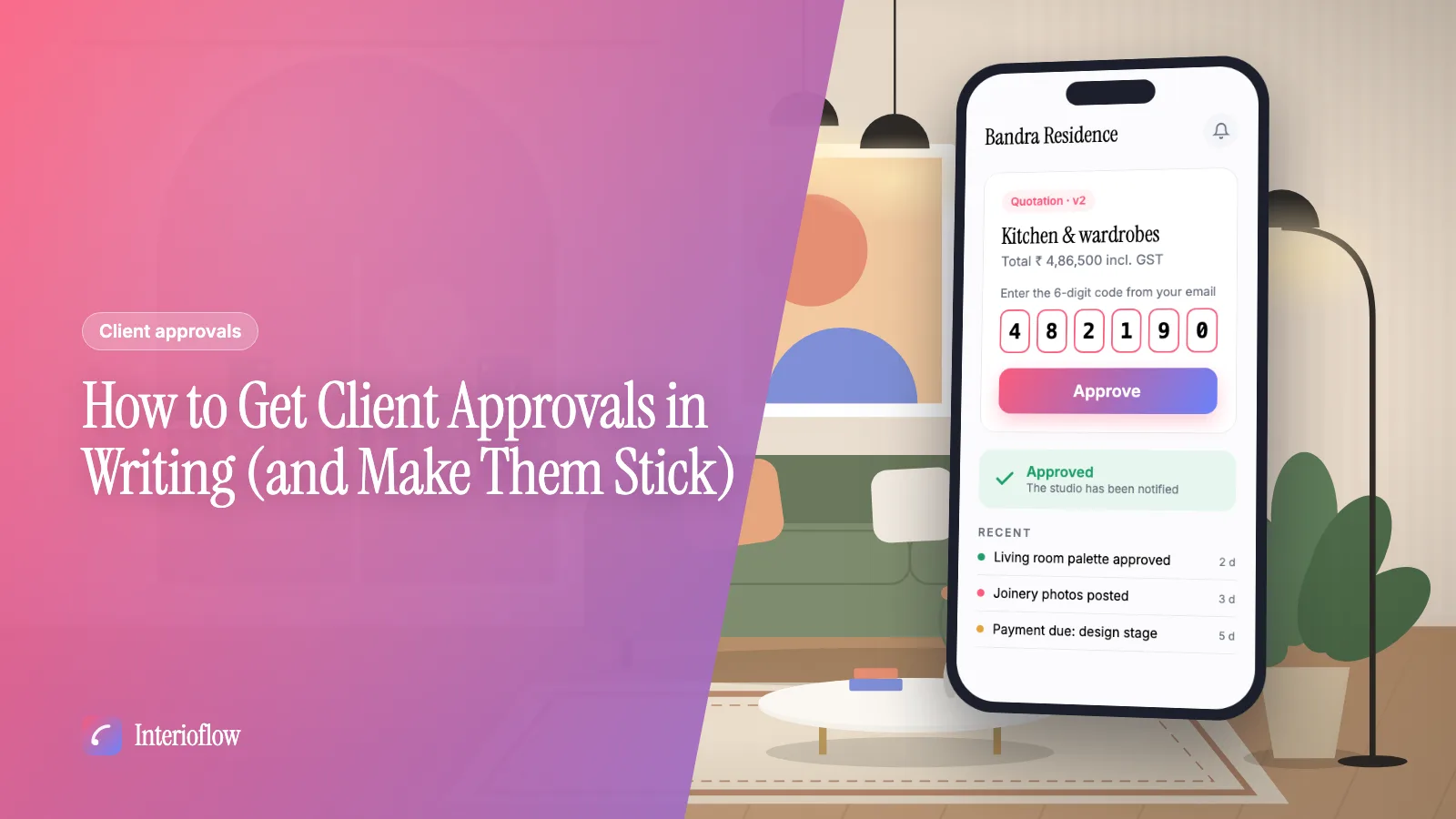
From a site's Design approvals tab you send a request for a specific thing (a layout, a 3D view, a material and finish, lighting, an agreement, payment terms and so on) with a title, a note for the client, drawings or renders attached, and an optional reply-by date. If you want the client to choose, you can offer between two and six options, each with its own image, and they have to pick one to approve.
The client answers from their own portal: approve, request changes, or reject. Changes and rejections need a short reason, so you never get a bare "no". If they ask for changes, you revise and resend it as v2, v3 and so on, and every earlier answer stays in the history. A request that's due the next day or already overdue gets a reminder to the client at 9 in the morning, so you aren't the one doing the chasing.
For the decisions that need a firmer yes, the client confirms with a 6-digit code emailed to them. That's switched on automatically for agreements and payment terms, and you can turn it on for anything else. The same code step applies when a client approves a quotation, a deadline change or a material charge, and each one is written to the site's activity trail. More on the money side is on the client approvals page.
It isn't magic. Clients still change their minds. But when they do, it shows up as a new version with a clear history, rather than an argument about a WhatsApp thumb.
Quick answers
How do I get client approval in writing for an interior design project? Send each decision as its own short request with the drawing or sample attached, a clear question and a reply-by date. Ask the client to reply with an explicit yes to that specific version, and keep the request, the attachment and the answer together in one place you can find later.
Is a WhatsApp "ok" a valid client approval? It's better than nothing, but it's weak. A thumbs-up under a photo rarely says which version was approved, and the thread gets buried within a week. Treat it as a reminder to send a proper approval, not as the approval itself.
What should I do when the client keeps changing their mind? Don't argue the taste, change the process. Every approved item stays approved; a change becomes a new version with its own cost and time impact, and the client signs off on that too. Most clients slow down once they see a change written as a number of days and rupees.
Which interior design decisions need formal sign-off? Anything that's expensive or slow to undo: layout, kitchen and wardrobe drawings, laminate and finish choices, lighting and electrical points, the quotation and the payment terms. Small styling calls can be informal.